Our sustainability management
Basic Policy for Sustainability
In recognition of the importance of establishing a corporate structure capable of adapting to any changes in the business environment, the Mitsubishi Steel Group has adopted sustained and global growth based on the development of competitive businesses as its fundamental management policy. We aim to be a more reliable business by fulfilling our social mission, and we will contribute to the realization of a sustainable society through dialogue with all stakeholders, including customers, suppliers, shareholders, employees, and local communities, based on our Corporate Philosophy, the Mitsubishi Steel Group Code of Conduct, and the Detailed Rules for Mitsubishi Steel Manufacturing Group Corporate Code of Conduct.
Environment
The Mitsubishi Steel Group will get actively involved in protecting the environment in all aspects of business activities with a heightened awareness that conservation of the global environment is one of the most crucial challenges facing mankind.
Social
The Mitsubishi Steel Group will respect human rights, character, individuality, and diversity, seeking to galvanize the company by fostering human
resources as well as ensuring a safe and pleasant work environment.
Governance
In its global business activities, the Mitsubishi Steel Group will comply with the laws and regulations or code of ethics in society for transparent, fair, and equitable transactions under free competition, pursue optimal corporate governance at all times to maximize corporate value, and continually strive to enhance these efforts.
Our sustainability promotion structure
Our Sustainability Committee (chaired by the President & CEO) meets in principle at least once every three months to discuss topics related to sustainability, to submit and report on priority topics to the Board of Directors, to make decisions on priority sustainability topics, and to monitor responses.
We’ve also established the Global Environment Committee and the Carbon Neutral Committee under the umbrella of the Sustainability Committee as Companywide management organs intended to promote sustainability initiatives across the Company, including the assessment and management of sustainability-related risks and opportunities.
In addition, in April 2024, we recognized the ESG Subcommittee as the ESG Promotion Office to enhance its secretariat functions as an organization to further improve and advance initiatives and disclosure regarding ESG topics.
Our sustainability promotion structure
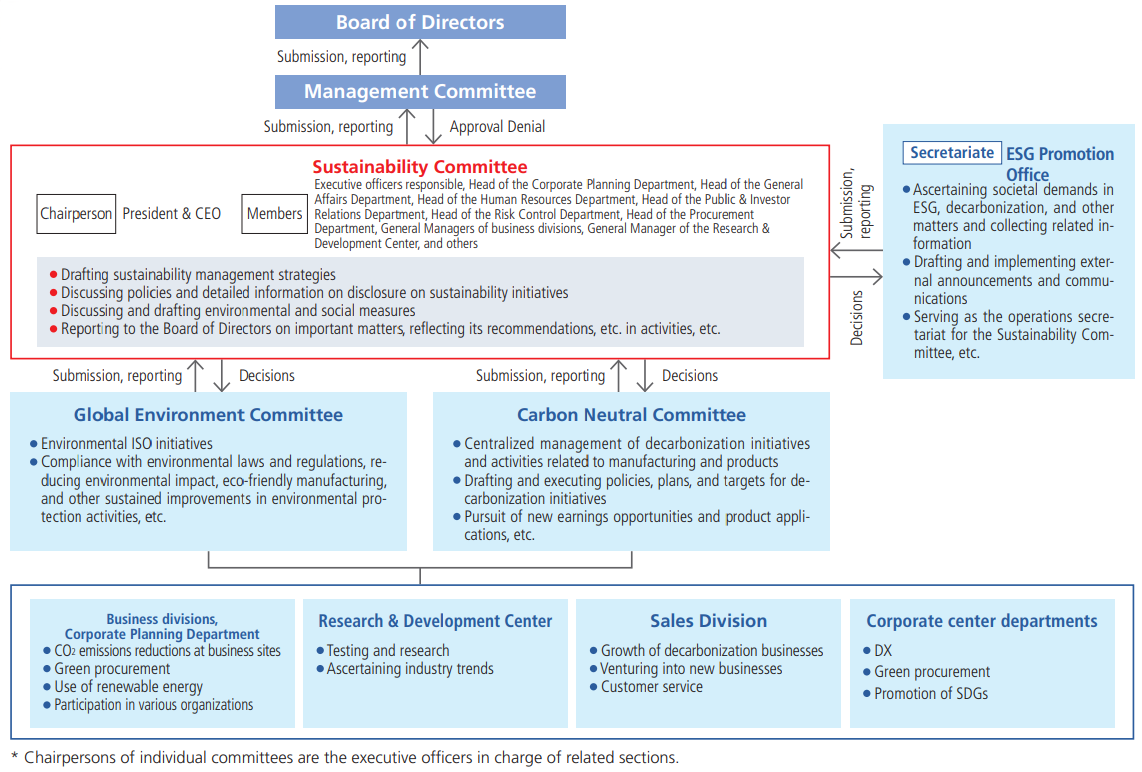
- ※ Global Environmental Committee conducts management reviews as internal environmental audits in accordance with ISO 14001 requirements, focusing on energy use and GHG emissions. In addition, we carry out awareness training so that all employees acquire the necessary knowledge on energy conservation and environmental protection.
Priority materiality items
To accelerate sustainability management and identify effective solutions, we have identified priority materiality items that can contribute to continuing growth and corporate value growth by realizing our ideal vision and management goals.
We selected four priority materiality items from the themes identified along the axes of internal importance and importance to stakeholders and organized them based on their connections with the Sustainable Development Goals (SDGs).
We’re also reexamining and revising these priorities on an annual basis in light of considerations such as contemporary social conditions and the changing business environment, as well as dialogue with external stakeholders, including investors.The results are subject to approval by the Board of Directors.
We will help establish a sustainable society while realizing sustained growth and increasing corporate value by promoting efforts to identify solutions to these items.
Materiality identification process
In FY2019, we identified the Group’s materiality items through the following process. Since then, we’ve performed annual reviews to identify any changes in their significance in light of changing internal and external conditions.
Selecting topics based on the 17 goals and 169 targets of the SDGs, various guidelines, details of ESG evaluation items, social trends, Company status, and dialogue with investors and other external stakeholders
Prioritizing identified topics based on internal significance and importance to stakeholders
Identifying materiality topics based on priorities and discussing them in Sustainability Committee meetings (Management Committee meetings in initial identification), then disclosing them externally as material items following approval from the Board of Directors
Priority materiality items for the Mitsubishi Steel Group
| Materiality item | Initiatives | Related Pages | Corresponding SDGs |
|---|---|---|---|
| Providing products that contribute to social solutions | We’re promoting the development of both existing five businesses and new businesses as strategic businesses capable of making major contributions to market growth and social solutions by leveraging unique strengths. |
Overseas steel bars (P.82) Springs for commercial vehicles and rolling stock (P.84) Special alloy powders (P.86) Precision spring components (P.84) Offshore wind power products (P.88) New businesses (P.56) |     |
| Eco-friendly manufacturing |
|  | |
| Promoting human capital management |
|     | |
| Enhancing governance |
|  |