Disclosure based on TCFD recommendations

In November 2021, we announced our support for the recommendations of the Task Force on Climate-related Financial Disclosures (TCFD). We disclose information on business risks and opportunities associated with climate change and their financial impact based on this TCFD framework.
Governance
Management structure for addressing climate change
The Mitsubishi Steel Group strives to achieve ongoing improvements in environmental management by developing an ISO 14001 environmental management system and maintain related systems Groupwide.
- Mitsubishi Steel’s Sustainability Committee (chaired by the President & CEO) meets once every three months in principle to deliberate on matters related to sustainability, including climate change. Its other activities include submission and reporting on important matters to the Board of Directors, making decisions on sustainability, and monitoring the status of responses.
- We’ve established a Companywide management structure to promote sustainability through means including assessing and managing climate change risks and opportunities. This structure includes, as organizations under the umbrella of the Sustainability Committee, the Global Environment Committee and the Carbon Neutral Committee.
- In November 2021, we announced our support for the recommendations of the Task Force on Climate-Related Financial Disclosures (TCFD). In 2022, we implemented disclosures based on the TCFD recommendations for the first time. In 2025, we reassessed risks and opportunities by business division, carried out scenario analysis and assessment of financial impacts, and reviewed the responses once again.
- In 2023, having set the goal of carbon neutrality, we set more aggressive CO2 emissions reduction targets for the Steel Bars segment. We made these targets still more aggressive in 2024, targeting a 50% reduction relative to the base year as the midterm target for FY2030 (vs. the previous target of a 30% reduction), through use of CO2-free electricity and general energy conservation activities (e.g., introducing energy-saving equipment).
| Sustainability Committee | Carbon Neutral Committee | ESG Promotion Office | |
|---|---|---|---|
| Roles in addressing climate change issues | Implementing TCFD scenario analysis and formulating policies for addressing climate change and details thereof | Drafting and executing policies, plans, and targets for efforts to achieve carbon neutrality | Collecting external information on climate change and communicating this information internally and externally |
| Details of FY2024 activities related to climate change | Held 8 meetings in 2024, including five meetings for discussions of agenda items related to climate change.The Board of Directors was also informed of the contents discussed at the Sustainability Committee. | Set a more aggressive MSM Group CO2 emissions reduction target for FY2030, which had targeted only a 30% reduction when converted to total emissions. The new target is a 50% reduction. Joined the GX League; obtained independent validation of Scope 1, 2, and 3 emissions for the Group, including overseas subsidiaries. | Reviewed risks and opportunities related to the effects of climate change anew to enhance disclosures based on TCFD recommendations.In addition, we have expanded our climate-related disclosures by issuing a new integrated report and holding ESG briefings. |
For information on the sustainability structure, please refer to the sustainability promotion system.
Strategy
Scenario analysis assumptions
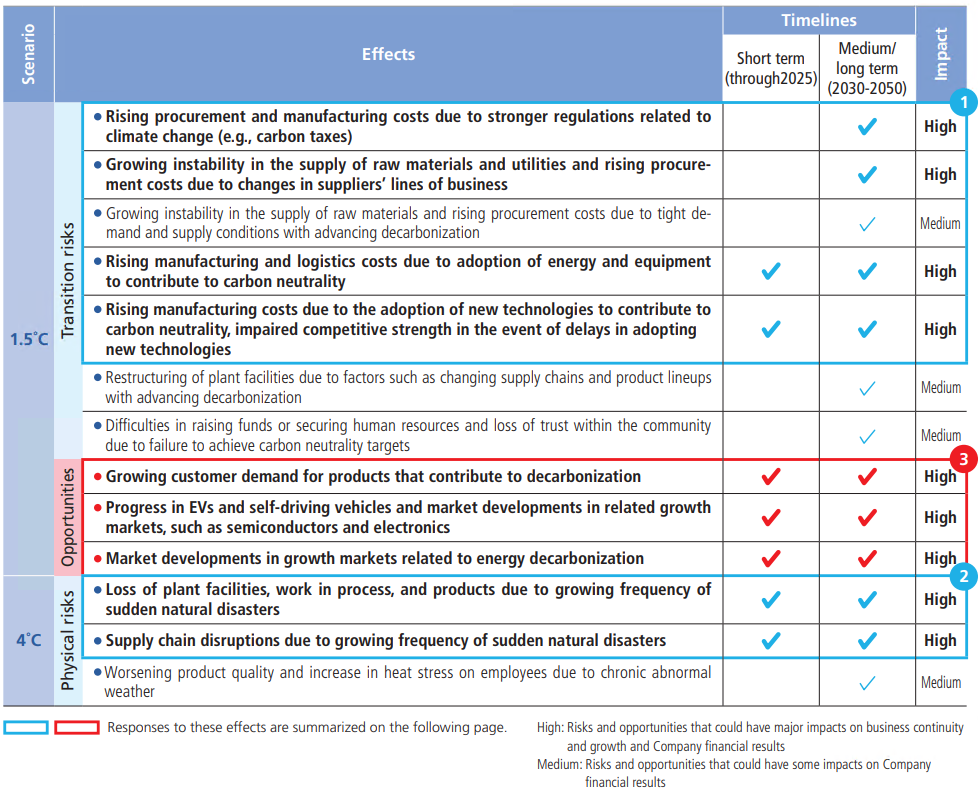
- The Company carried out scenario analysis of its businesses in Japan over the course of the timelines leading to 2030 and 2050 based on two scenarios: a scenario in which global measures to address climate change succeed in keeping the increase in average temperatures by the end of the century to less than 1.5℃ (the 1.5℃ Scenario, in which mainly transition risks are manifested due to factors such as regulations related to climate change) and a scenario in which such measures remain inadequate (the 4℃ Scenario, in which mainly physical risks are manifested due to factors such as increasing natural disasters).
- Scenarios published by the International Energy Agency (IEA) and other authorities were referred to in the scenario analysis. The 1.5℃ Scenario and the 4℃ Scenario are summarized below.
| Risks | Vision of society under each scenario | External scenarios referred to in scenario analysis |
|---|---|---|
| 1.5℃ Scenario (transition risks) |
| International Energy Agency (IEA) World Energy Outlook Report 2023
|
| 4℃ Scenario (physical risks) |
|
- *1APS: Announced Pledges Scenario, NZE: Net Zero Emissions Scenario, SDS : Sustainable Development Scenario
- *2SSP5: Scenario under which global economic development continues to depend on energy from fossil fuels; RCP8.5: high emissions scenario under which emissions continue to increase throughout the 21st century
- *3Certified non-fossil-fuel electricity
Status of response initiatives
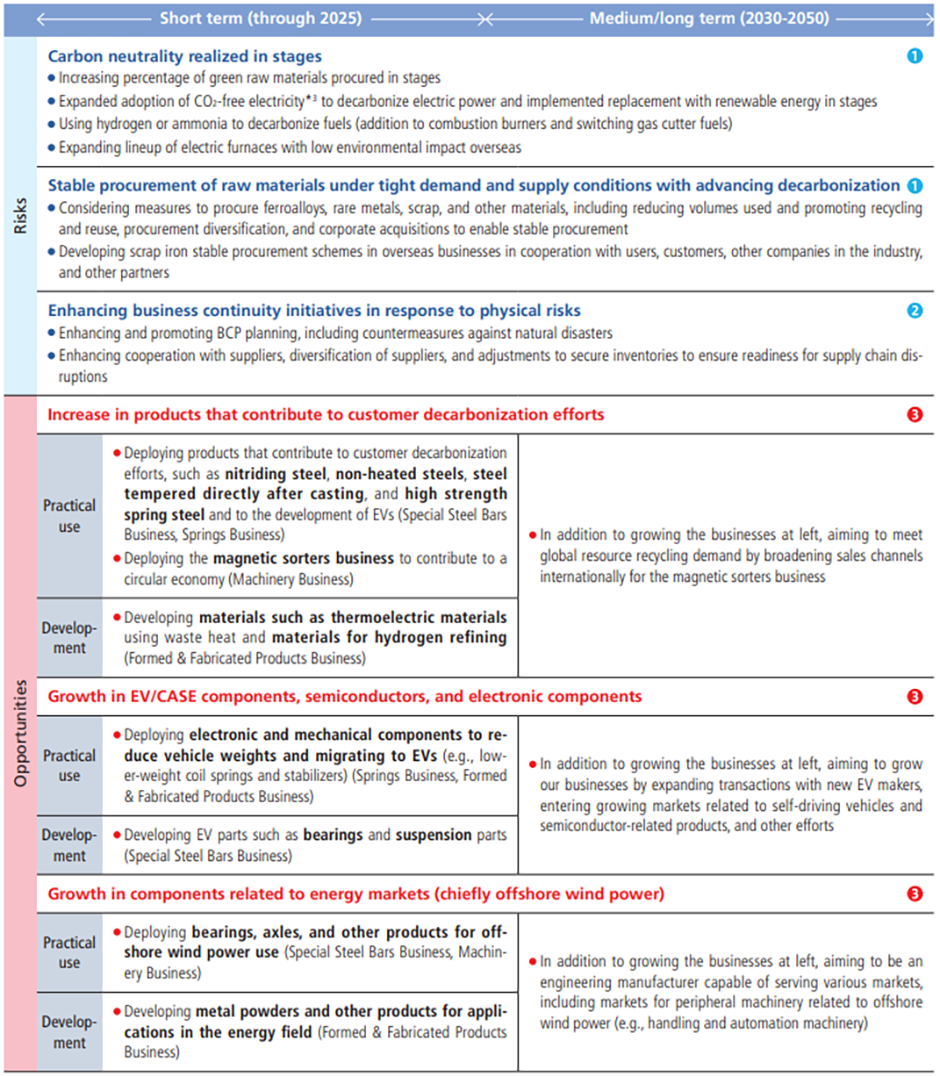
We are promoting emissions reduction plans to achieve carbon neutrality in stages, and recently these are proceeding smoothly. We’ve identified as a materiality item the supply of products that help solve social issues. In addition, we will promote preparations for supplying materials such as green steel and powders, and are proceeding with capital investments to develop products for EVs, reduce spring weights, and meet future growth in demand for offshore wind power-related products.
For further details on our other initiatives, please refer to the page below.
Efforts to lessen environmental impact| Mitsubishi Steel
Growing strategic businesses(2023 Mid-term Business Plan)
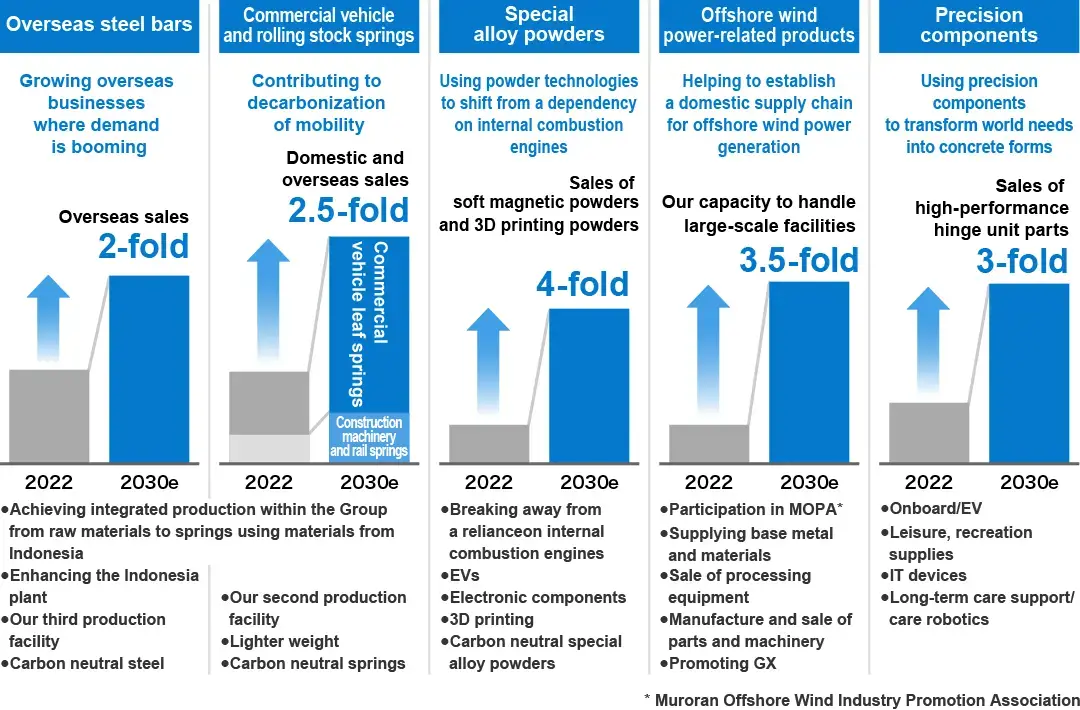
- We have incorporated each of the products identified in the scenario analysis as a response to opportunities with significant financial impact into the “2023 Mid-Term Business Plan” as strategic businesses to be nurtured going forward. We will continue to grow these strategic businesses and raise the ratio of strategic businesses to 50% in order to transform our business portfolio and achieve sustainable management.
Strategic resilience
- Since climate change can cause major impacts on our businesses, both in the form of risks and opportunities, we recognize it as a key management issue for Mitsubishi Steel's medium-to long-term growth.
- Under the 1.5°C Scenario, in which global measures to address climate change are successful, we anticipate that climate change regulations, including carbon taxes, would be enhanced. Thus, efforts toward carbon neutrality would be essential in areas such as raw materials and manufacturing processes. While striving to realize carbon neutrality in stages, we will enhance sales of products in new growth markets created by decarbonization. These products include products that contribute to decarbonization by customers (e.g., carbon-neutral steel, springs, and special alloy powders*4); EV and CASE components; semiconductors and electronic components; and energy-related components, wind power components in particular. We will contribute to the pursuit of decarbonization while growing our businesses by focusing on increasing orders received for products related to offshore wind power and products that contribute to a circular economy (e.g., magnetic sorters) as well as marketing marketing metal powders such as soft magnetic powders (for electronic components, including those for CASE applications).
- In the 4℃ Scenario, in which global measures to address climate change remain inadequate, the impact of transition risks would be limited compared to the 1.5℃ Scenario. However, we would enhance business continuity planning while maintaining and managing the supply chain by diversifying suppliers, maintaining appropriate inventories, and other measures, since underthis scenario, loss of plant facilities and products, supply chain disruptions, and other such incidents would be expected torise due to an increase in sudden natural disasters.
- In the face of climate change, we are studying and implementing various responses intended to mitigate risks and secure opportunities. These include efforts to achieve carbon neutrality and to gain entry intomarkets expected to experience growth due to climate change, andverifying the resiliency of business operations based on analyses of multiple scenarios.Going forward, we plan to promote various measures more effectively by updating and monitoring information related to these analyses.
- *4Steel bars,springs and powders manufactured using CO2-free electric power
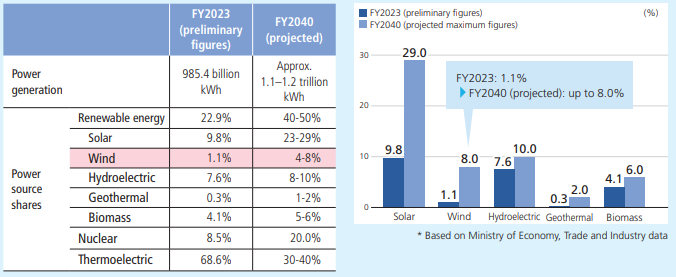
The share of renewable energy demand accounted for by wind power is projected to grow from 1.1% in FY2023 (preliminary figures) to as high as 8.0%. In response, we’re promoting product development and other activities to expand sales channels in our businesses related to renewable energy, including sales channels for devices related to offshore wind power.
Risk management
Climate change risk management structure
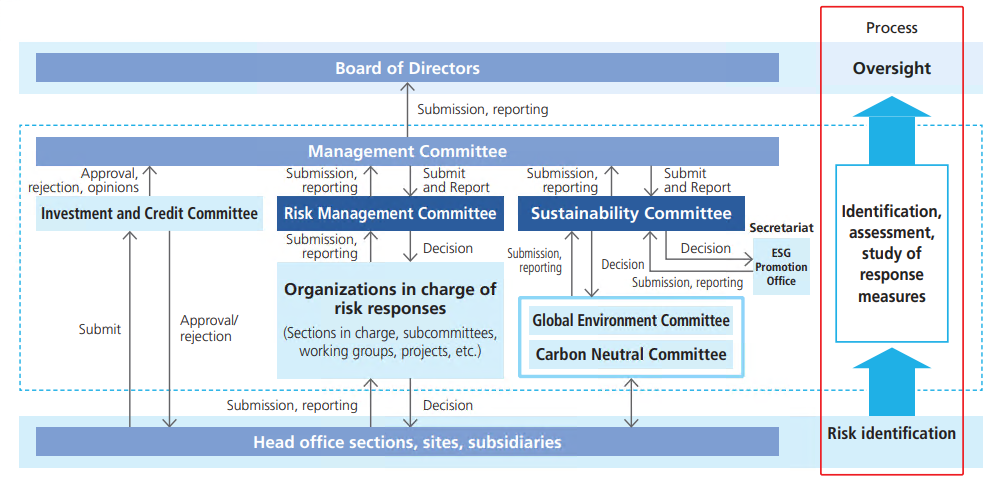
- Our basic structure for managing climate change risks consists of the Sustainability Committee, which manages transition risks, and the Risk Management Committee, which manages physical risks and other risks.
- Our risk management process involves identifying Companywide short-, medium-, and long-term risks; assessing these risks; and considering measures in response through discussions at the Risk Management Committee and Sustainability Committee under the supervision of the Board of Directors.
- The Investment and Credit Committee, led by the Corporate Planning Unit, reviews business plans and risks and deliberates on capital investments including those related to carbon neutrality.
- The Risk Management Committee formulates, verifies, and reviews business continuity plans (BCPs) to ensure that each section,site, and subsidiary can respond to and recover from natural disasters without delay.
Indicators and Goals
For indicators and goals towards achieving carbon neutrality, please refer to "Efforts towards Carbon Neutrality."