Carbon neutral initiatives
Medium- to long-term vision
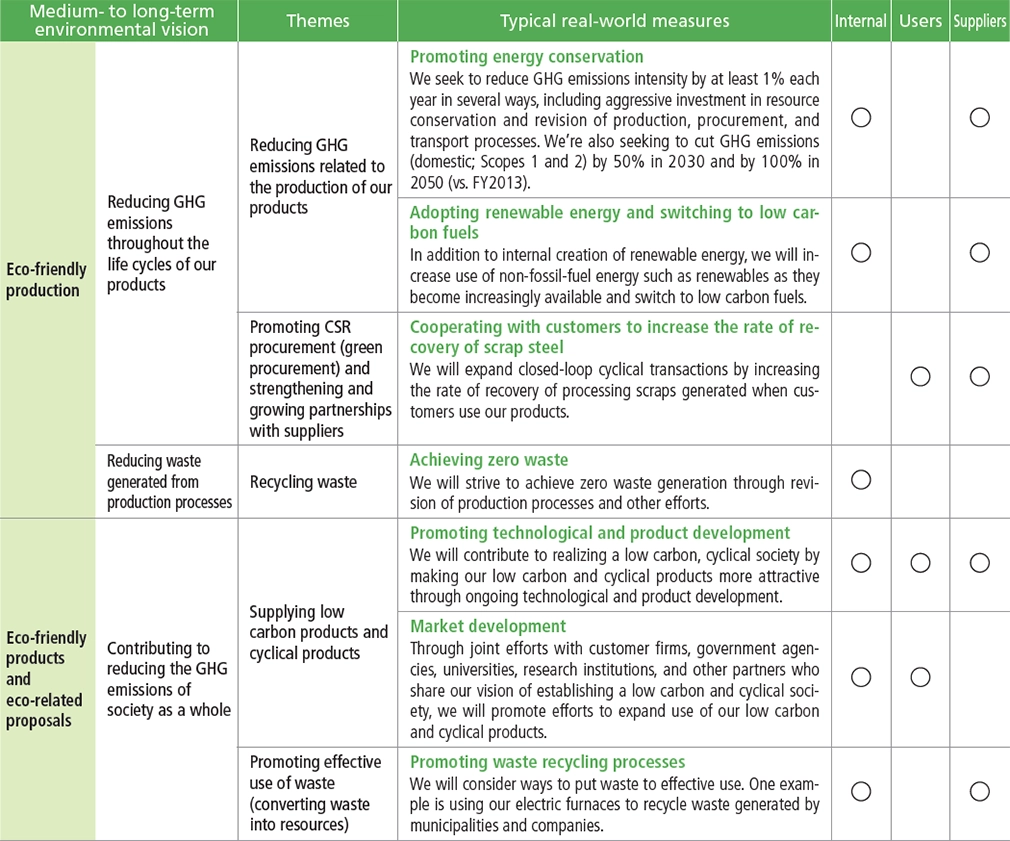
The Mitsubishi Steel Group will take action toward its ideal vision for 2050 guided by the following medium- to long-term vision:
GHG emissions reduction
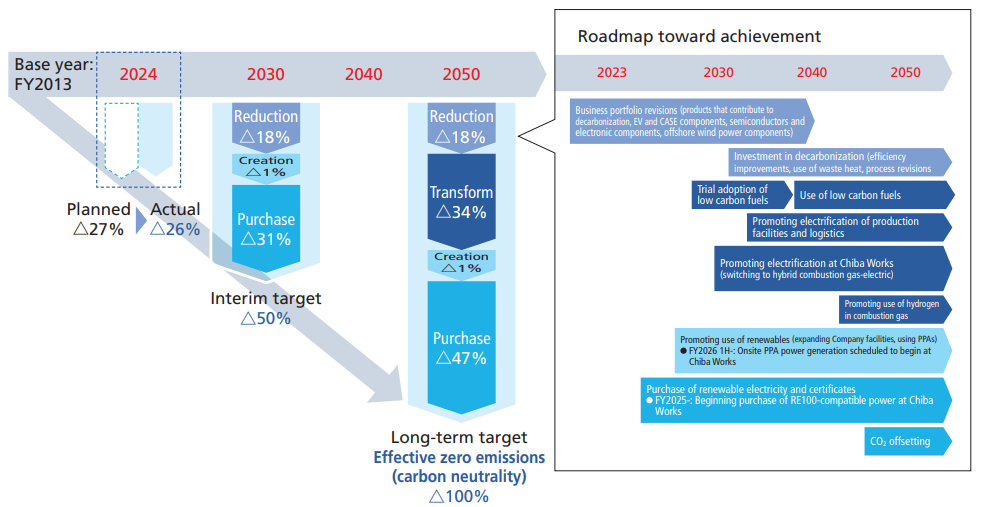
The Group is striving to reduce its environmental impact and GHG emissions in the value chain, from procurement to manufacturing and transport.
■Life-cycle GHG emissions
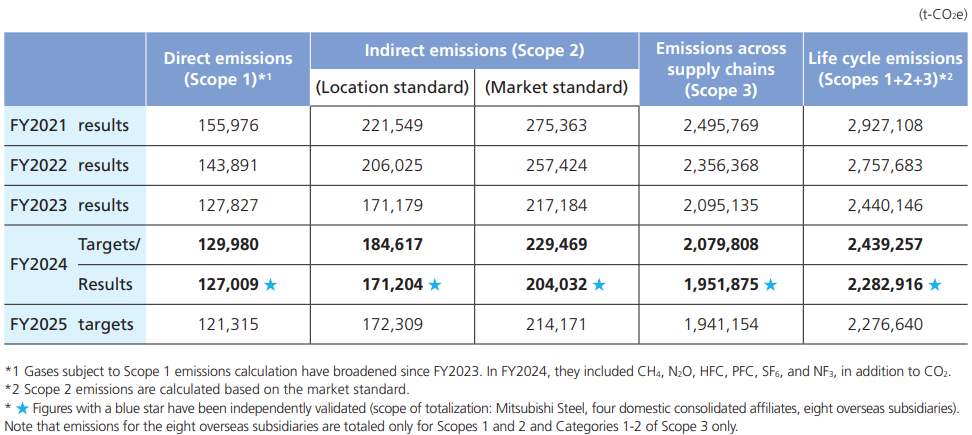
■Trend in Scope 1, 2, and 3 GHG emissions
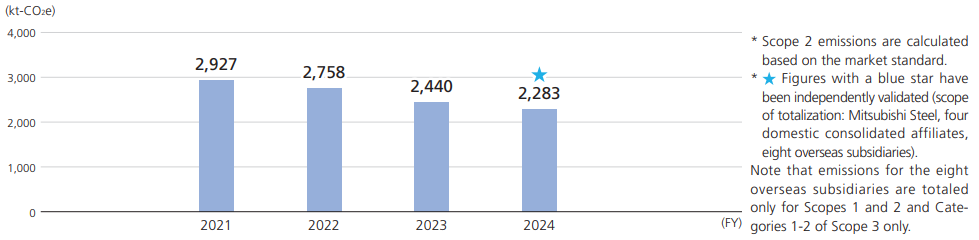
■Scope 1, 2, and 3 emissions
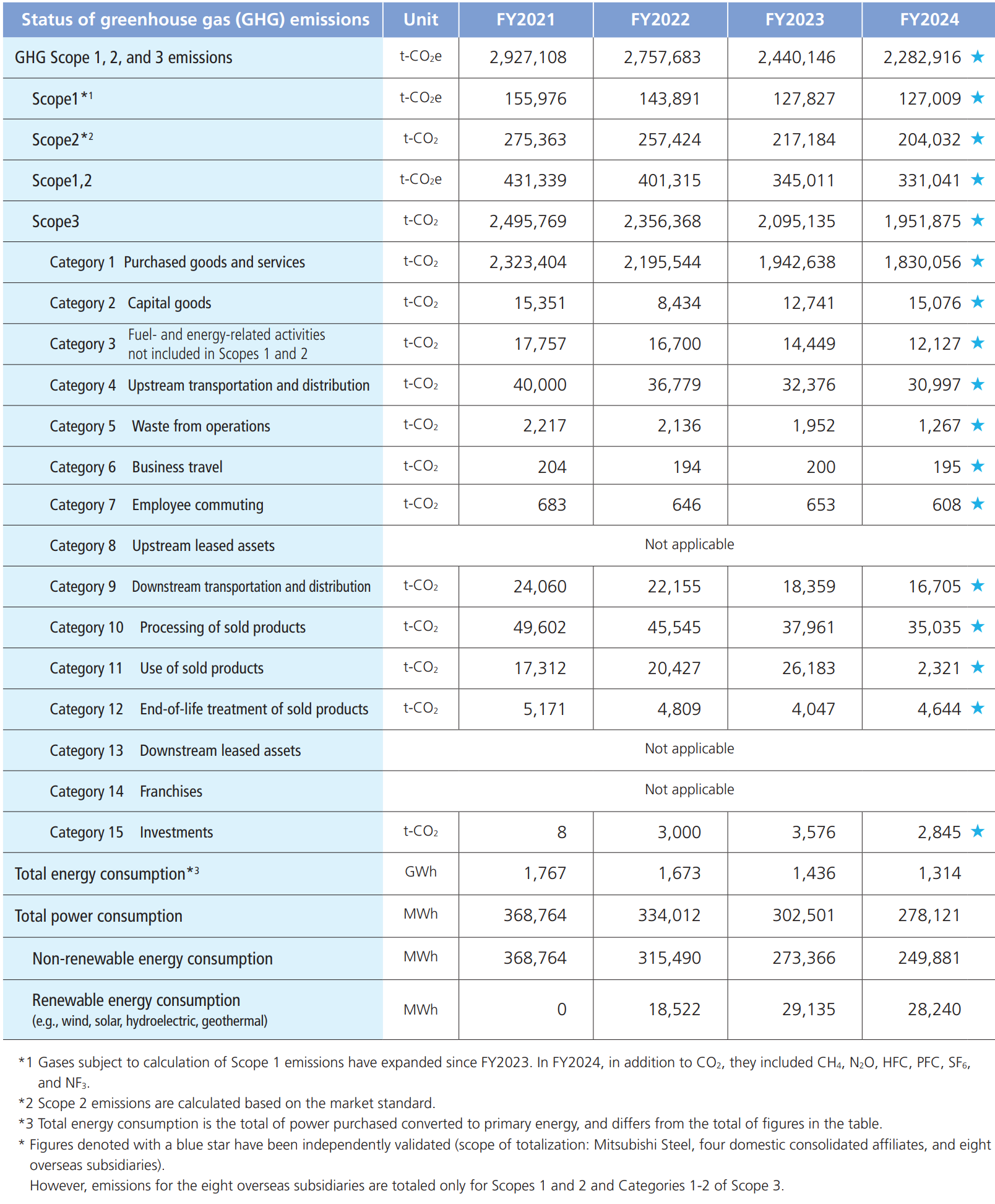
Efforts toward achievement of targets
Since the second half of FY2022, we have promoted capital investments related to carbon neutrality by using ICP to reflect CO2-reduction effects as virtual prices in domestic businesses.
- Domestic carbon price: 10,000 yen/t-CO2
- Scope: Capital investments in domestic businesses
As advised by the Nomination and Compensation Committee, the Board of Directors has decided to revise our executive compensation programs to incorporate nonfinancial indicators in the assessment indicators for bonuses and stock-based compensation, and we adopted these revisions in FY2023. Achieving these targets is reflected in payment amounts.
The Chiba Works switched to purchasing 100% CO2-free electricity in April 2022. The Hirota Works also completed full switchover to CO2-free electricity in April 2023. This means that two of Mitsubishi Steel’s four main plants have switched completely to CO2-free electricity.
| Site | CO2Projected CO2 emissions (vs. before adoption of CO2-free electricity) | Time of adoption |
|---|---|---|
| Chiba Works | Reduced by approx. 8,300 t (approx. 50%) | April 2022 |
| Hirota Works | Reduced by approx. 7,600 t (approx. 90%) | March 2023 |
- We will promote the adoption of energy-saving technologies at each facility in accordance with each country’s carbon neutrality targets.
- Our Indonesian subsidiary JATIM has acquired fossil-free certificates and switched to 100% power from renewables in October 2025.
As a result, JATIM’s CO2 emissions have declined by about 80%, while those of all Group overseas operations and all consolidated subsidiaries, respectively, have declined by 50% and 25%.
Mitsubishi Steel supports the GX League Basic Concept, which calls for reforming economic and social systems as a whole while contributing to corporate growth, consumer wellbeing, and the planet, with the goals of achieving carbon neutrality in 2050 and preparedness for future societal change. We will continue to contribute to a carbon-neutral society through efforts to reduce CO2 emissions while adopting energy-saving technologies at various facilities in accordance with the carbon neutrality targets set in their respective countries.

he Company has earned a score of “B” for Climate Change in the recent survey by the Carbon Disclosure Project (CDP)*. This is our first “B” score. The third highest of the CDP’s eight levels, the “B”score corresponds to the Management Level, indicating that the Company recognizes and acts on its environmental risks and their impacts.
※The CDP is an international nonprofit that assesses the environmental strategies and initiatives of businesses, local governments, and other organizations on eight levels and discloses its findings.
The Group’s GHG emissions and environmental performance data (water intake and waste [Japan only]) for FY2024 (April 2024 – March 2025) have been independently validated in accordance with JIS Q 14064-3:2023 (ISO 14064-3:2019), and an assurance report has been obtained from SOCOTEC Certification Japan, a validation agency, to provide stakeholders with highly reliable, transparent data.
Scope of coverage
Mitsubishi Steel Mfg. Co., Ltd. and its consolidated Group (four subsidiaries in Japan and eight subsidiaries overseas)
Period covered
April 1, 2024 – March 31, 2025
Subjects
Greenhouse gas (GHG) emissions from business activities (Scope 1, Scope 2, and Scope 3 [Categories 1-7, 9-12, and 15]) and environmental performance data (water intake and waste [Japan only])
Efforts to lessen environmental impact
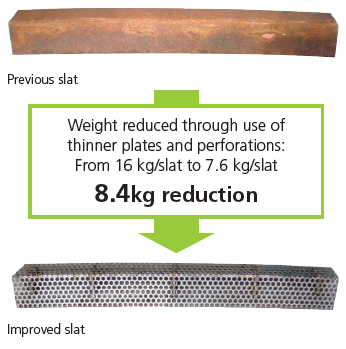
Energy conservation in tempering furnace conveyors for automotive coil springs (Chiba Works)
The Chiba Works has reduced the weight of the conveyor slats installed on the conveyors used in the tempering furnace process for automotive coil springs by switching to thinner, perforated slats. This has reduced the energy used in heating (which is sourced from city gas supplies). (The annual energy savings are equivalent to a reduction of approx. 560 t in CO2 emissions.)
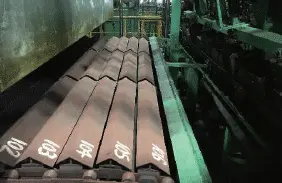
Reducing CO2 emissions through use of hydrogen as an alternative cutting gas for cutting steel bars (Muroran Works) * A Challenge Zero Emissions project
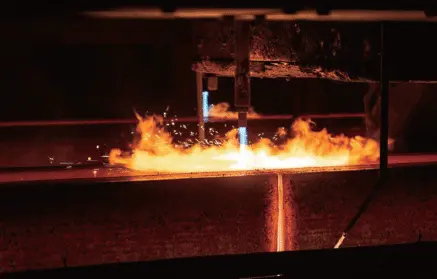
LPG-gas cutting equipment is used to cut slabs cast in continuous casting equipment to appropriate lengths for final products. The Muroran Works aims to reduce CO2 emissions from this process to zero by switching from LPG to hydrogen.
The Muroran Works is working to replace LPG with hydrogen as the cutting gas used to cut slabs cast in continuous casting equipment through a series of steps from the testing and inspection stage through permanent equipment modifications.