Corporate governance
Recognizing the importance of establishing a corporate structure capable of responding to any changes in business conditions, the Group has adopted sustained global growth based on development of competitive strengths in businesses as its fundamental management policy. For this reason, we regard as vital efforts to enhance corporate governance and carry out swift and reasonable management decision-making while securing functions related to checks and balances.
Corporate governance structure
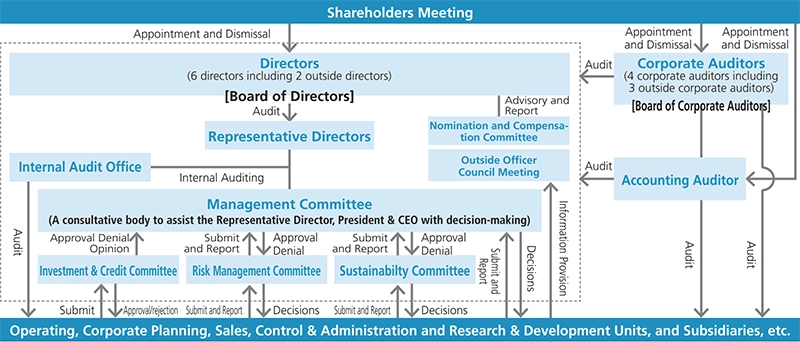
We keep our Board of Directors to the minimum size needed. As part of efforts to ensure efficient oversight of business execution, we’ve established the Nomination and Compensation Committee and the Outside Officer Council Meeting as subsidiary organizations under the Board of Directors.
To mitigate business risks, we’ve also established various committees capable of objective, transparent, expert discussions of investment and credit, risk management, and sustainability.
To ensure mutual cooperation, the management meeting and the Board of Directors may request reports on important matters discussed by these committees. The important topics discussed in committees are shared with the management meeting and the Board of Directors when reporting is requested, to improve cooperation.
Furthermore, the Board of Corporate Auditors, Internal Audit Office, and accounting auditor work together toward more effective auditing of business execution.
We strive to enhance various functions and intensify cooperation so that these governance systems can function even more efficiently. With that in mind, we plan to discuss the optimal organizational design for the Company.
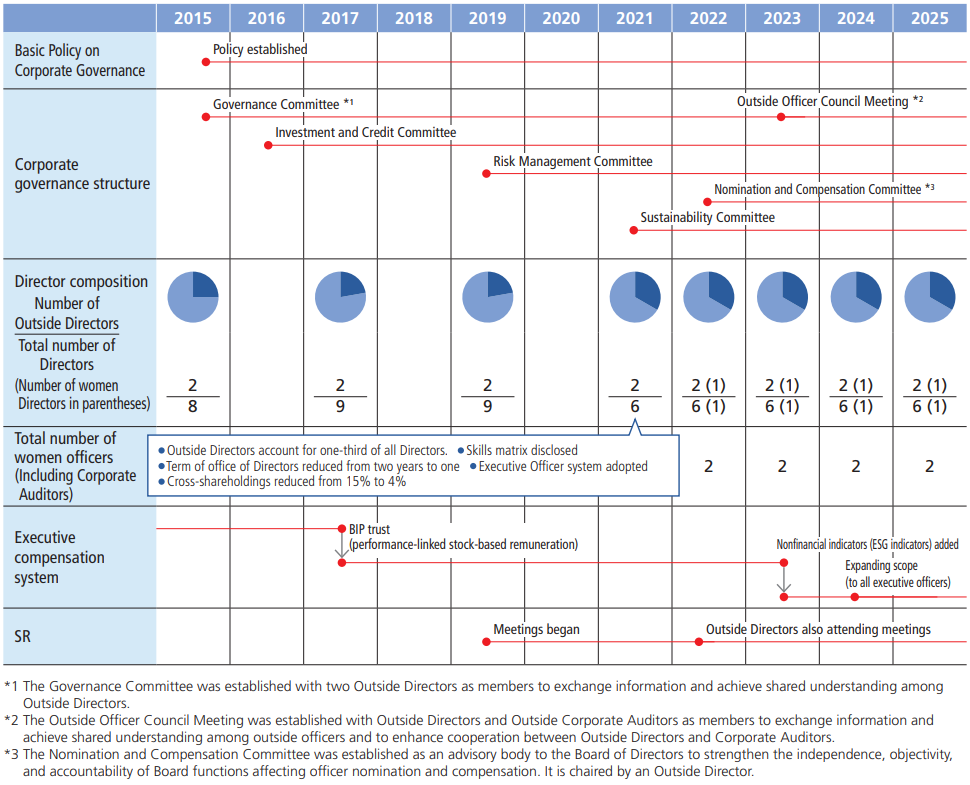
The Group has sought to enhance corporate governance to increase both transparency and objectivity. To strengthen the diversity of the Board of Directors, it has appointed women for the position of independent Director and Corporate Auditor.
The views of outside officers are already reflected in officer personnel decisions made by the Governance Committee.Nevertheless, in 2022, we established an independent Nomination and Compensation Committee to encourage discussions of even greater depth. By doing so, we’re seeking to ensure transparency through nomination and compensation measures that reflect recent trends.
The Governance Committee has been reorganized into the Outside Officer Council Meeting to contribute to a shared understanding of the issues through the close exchange of opinions and information among outside officers and to strengthen cooperation with the Board of Directors.
The Board of Directors consists of six Directors (including two Outside Directors) and four Corporate Auditors (including three Outside Corporate Auditors). It meets monthly in principle.The Board serves to steer management strategies. While striving to accelerate decision-making, under the leadership of the Director/Chairman of the Board it formulates basic management strategies, makes decisions on matters as provided for in laws, regulations, and the articles of association and on other important management matters, and oversees business execution by Directors. Directors are responsible for instruction of employees delegated business execution authority regarding policies and other matters decided by the Board, and the authorized persons carry out executive duties.In FY2024 the Board of Directors met 14 times,* with 100% of Directors and Corporate Auditors in attendance.
- ※In addition to the number of Board meetings above, one resolution approved in writing was deemed to constitute a decision of the Board of Directors.
Key categories of topics discussed by the Board of Directors in FY2024 and number of topics
| Category | Number |
|---|---|
| Management strategy ※1 | 22 |
| Sustainability management ※2 | 9 |
| Governance, risk management, internal controls | 39 |
| Settlement of accounts, finance | 35 |
| Human resources | 14 |
| Other | 10 |
| Proposals from outside officers ※3 | 2 |
Consisting of four Corporate Auditors (three of whom are Outside Corporate Auditors), the Board of Corporate Auditors meets monthly in principle and at other times as necessary. Under the leadership of the chairperson, the Board of Corporate Auditors ensures that the duties of Directors are performed in accordance with laws, regulations, and the articles of association by auditing the entire Group on audit policies, compliance based on division of responsibilities, crisis management, and other matters. In FY2024 the Board of Corporate Auditors met 15 times, with 100% of members in attendance.
| Category | Number |
|---|---|
| Accounting auditing | 8 |
| Status of corporate management | 9 |
| Audit activity reports | 10 |
| Status of performance of duties of officers and others | 2 |
| Audit policies and plans | 2 |
| Other | 8 |
Consisting of the Director/Chairman of the Board and two Outside Directors, and chaired by an Outside Director, the Nomination and Compensation Committee contributes to improving the transparency and objectivity of the Board of Directors’ functions regarding nomination and remuneration of the posts of Managing Executive Officer and above, through advising the Board on nomination and remuneration for such posts. In FY2024 the Nomination and Compensation Committee met 12 times, with 100% of members in attendance.
| Category | Number |
|---|---|
| Nomination Counselor and advisor systems, systems for new officers (Directors, Corporate Auditors), 360° evaluation of executive officers, etc. | 10 |
| Remuneration Decisions on expanding the scope of stock-based remuneration (BIP trust) and remuneration policies, nonfinancial indicators, etc. | 8 |
| Other | 2 |
Composed of six Outside Directors and Corporate Auditors, the Outside Officer Council Meeting meets once every three months to enhance oversight functions for business execution by the Board of Directors through free and open discussion intended to exchange information and achieve shared understanding. As necessary, Outside Directors propose topics discussed in the Outside Officer Council Meeting for discussion by the Board of Directors.
|
Efforts to enhance discussions in the Board of Directors
We seek to enhance discussion in the Board of Directors by developing a governance system to serve as the foundation of our sustained growth, through making the Board more effective and providing information to Outside Officers to enable appropriate management decision-making and oversight.
(1)Enhancements in information provision to outside officers
We strive to enhance discussions in the Board of Directors by proactively creating opportunities to provide information to outside officers on the Company business environment, management topics, and other matters, to reflect their insights in management.
Furthermore, we maintain systems to enable outside officers to conduct even more appropriate oversight of business execution through discussions on Company management topics between Outside Directors and those on the executive sideor among outside officers.
- Increasing outside officers’ understanding of Company management topics
- Providing new officers with training and opportunities to visit major business sites
- Swiftly providing materials for Board of Directors meetings and holding prior briefings for outside officers
(To enable the Board to concentrate on deliberation, for particularly important matters we provide opportunities for prior briefings on agenda items from the executive side, to enhance outside officers’ understanding of their details.)
- Providing opportunities for discussions among outside officers and with the executive side
- Outside Officer Council Meeting (meets four times/year)
This meeting provides opportunities for exchange of opinions among Outside Directors and Corporate Auditors concerning important Company management topics. We also facilitate cooperation by discussing topics addressed in the Outside Officer Council Meeting in the Board of Directors as necessary. - Offsite meetings between Outside Directors and the President (four times/year)
We established these new opportunities for discussion of important management topics by the President and Outside Directors in FY2 0 2 5. Topics discussed include formulation of the new Mid-term Business Plan, to take effect beginning in FY2026.
(2)Setting a strategic agenda for the Board of Directors
To enable the Board of Directors to focus on strategic topics, we have revised the standards for submittal and reporting to the Board to keep regular business execution reporting to a minimum and prioritize topics such as human capital management and medium- to long-term management topics. We also have established a structure for regular monitoring of the state of subsidiary management so that the Board of Directors can discuss subsidiaries promptly.
Through these initiatives, we have reduced agenda items, which previously had numbered about 200/year, by roughly 30%, devoting the time made available to discussion of matters such as medium- to long-term management strategies. As a result, in FY2024 the Board spent about 40% of its time on discussing medium- to long-term topics such as the Mid-term Business Plan and sustainability.

(3) Enhancement of officer training
To further enhance understanding of management topics and make the Board of Directors even more effective, we hold regular training for officers on subjects such as the latest business trends and changes in the business environment. This training supports knowledge acquisition to enable Directors to put their diverse perspectives andexpertise to use in strategic and appropriate decision-making.
| August 2024 | Sustained growth in corporate value from the investors’ perspective |
|---|---|
| March 2025 | Promoting enhanced discussions on strategies at the Board of Directors |
| September 2025 | About digital transformation (DX) |
Board Structure and Director Nominations
Thinking on Board of Directors balance, diversity, and size
Keeping the Board of Directors to the minimum necessary size to enable fast and efficient decision-making, the Company selects Directors who possess diverse experience, knowledge, and skills, without regard to attributes such as race, ethnicity, gender, or nationality. The result is a Board of ideal size and diversity. Appointing a Board on which more than one in three members are Outside Directors promotes fairness and transparency in decisions on business execution.

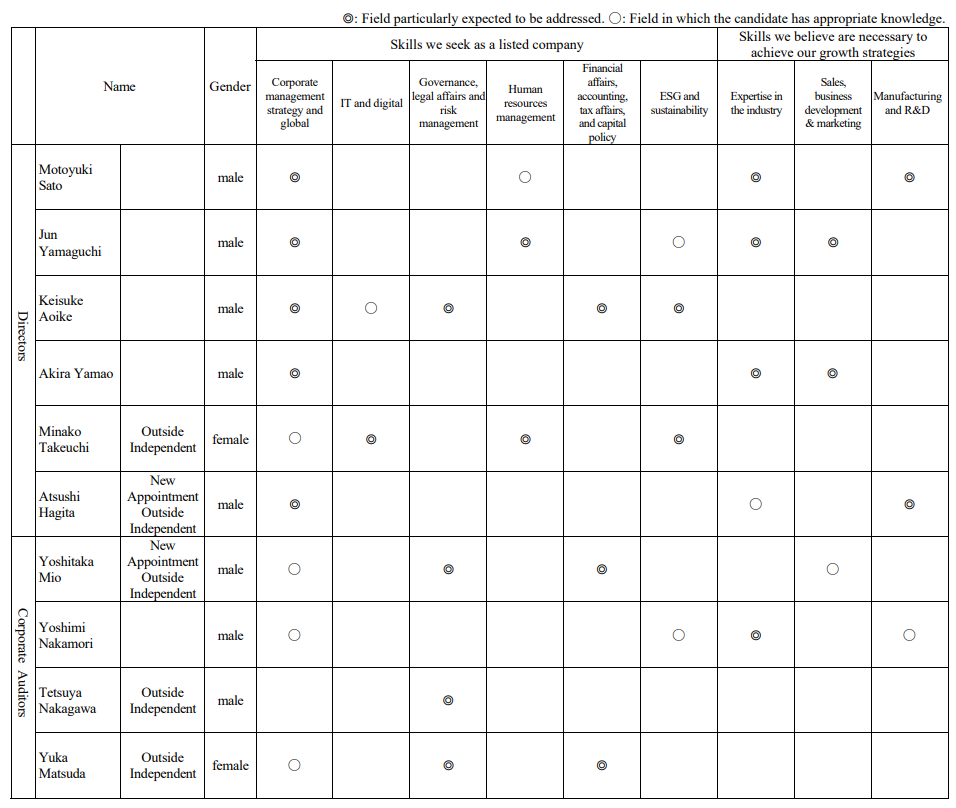
Skills demanded of Company directors and corporate auditors
Integrated production from materials to products is one of the Company’s key strengths. The Company seeks to achieve sustainable growth while contributing to society by responding effectively to the changing times and by providing products for a wide range of fields, including automobiles and construction machinery.
To achieve this goal, we understand that Directors and Corporate Auditors of diverse knowledge and experience engage in active discussions and in-depth deliberations in meetings of the Board of Directors.
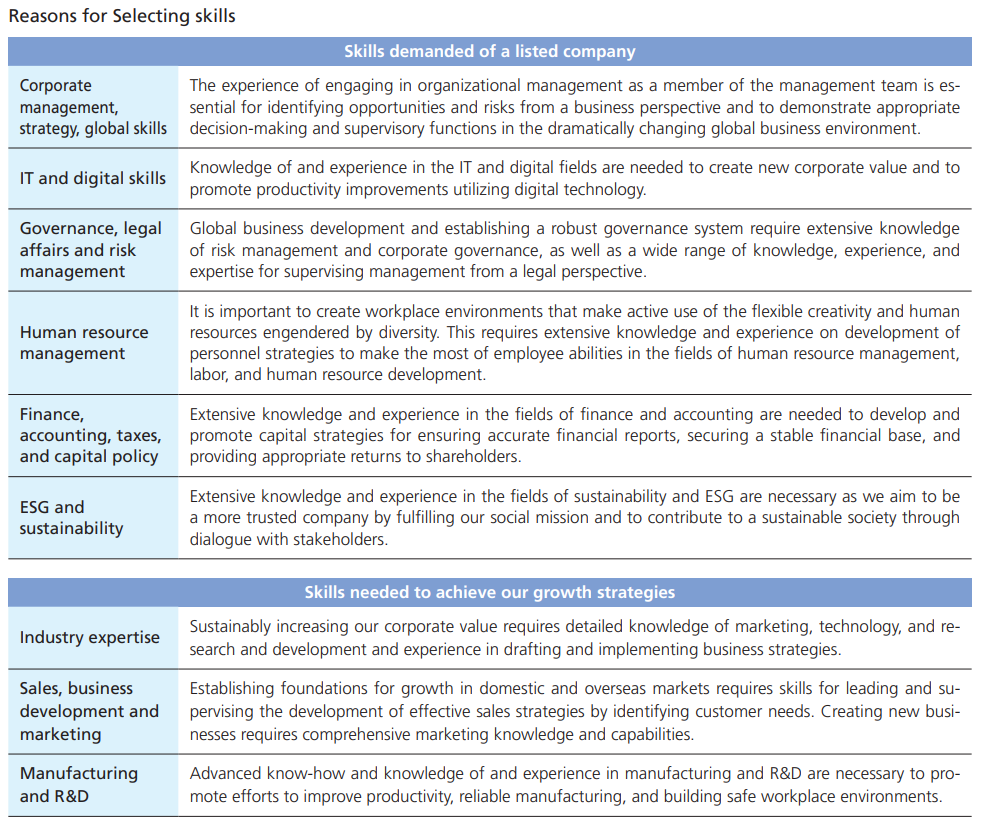
In particular, to strengthen our core businesses and grow our strategic businesses in a rapidly changing environment and to promote management focusing on human capital and sustainability (ESG), we believe it is essential that Directors and Corporate Auditors possess both the skills demanded of a listed company and the skills needed to realize our growth strategies.
The Company’s skills matrix and the reasons for selecting these skills are as shown below.
Independence criteria for outside officers
In addition to the independence standards set by the Tokyo Stock Exchange, we consider individuals who meet any of the following criteria to lack independence when appointing outside directors.
- 1Suppliers of the Company for whom the total value of transactions with the Company accounts for more than 2% of their consolidated net sales, or executives thereof
- 2Customers of the Company for whom the total value of transactions with the Company accounts for more than 2% of the Company’s consolidated net sales, or executives thereof
- 3Executives of major lenders to the Company (for whom the total amount of such lending accounts for more than 2% of the Company’s consolidated total assets)
- 4 Consultants, certified public accountants, attorneys, and similar parties receiving monetary or other financial benefits of 10 million yen or more per business year from the Company, not including officer remuneration
- 5Representative employees or other employees of the Company’s accounting auditor
- 6Major shareholders in the Company (those holding 10% or more of voting rights) or executives thereof
- 7Executives of organizations that received more than 10 million yen in donations or subsidiaries from the Company in the most recent business year
- 8Persons who have served as Company outside officers for longer than 10 years in total
- ※Persons who, at any point within the past three years, met any of the conditions listed in items (1) through (7) above.
Succession plan
The Company regards succession planning for top management and other core management to be a matter of the utmost importance. We address succession planning from a medium- to long-term perspective based on the Company’s management policies.
The Nomination and Compensation Committee, chaired by an Outside Director, formulates human resource requirements, deliberates based on multifaceted information in line with the following selection process, and reports to the Board of Directors.
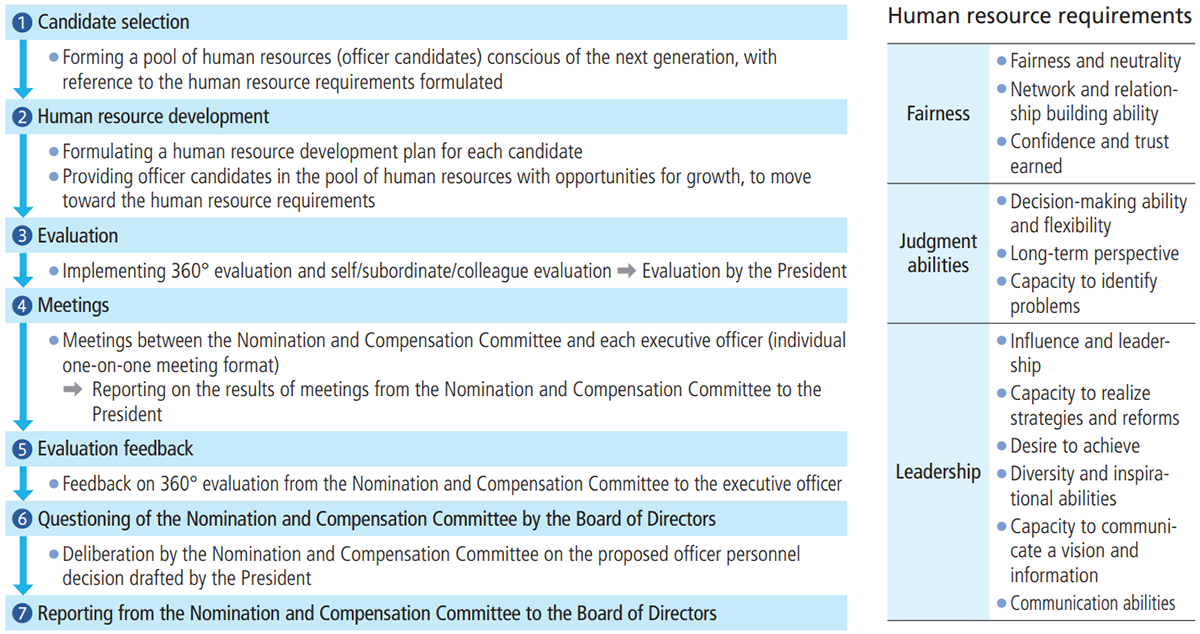
In addition, since FY2025, we have formulated a skills matrix for Board members and for executive officers not serving concurrently as Directors. This makes visible the skills possessed by candidates to succeed Board members.

Executive remuneration
Basic thinking on executive remuneration
- Design and structure of the compensation required to support the realization of the Corporate Philosophy and the Midterm Business Plan
- Balanced incentives to accelerate sustained growth
- Compensation systems to promote pursuit of social value with an emphasis on ESG
Composition of executive remuneration
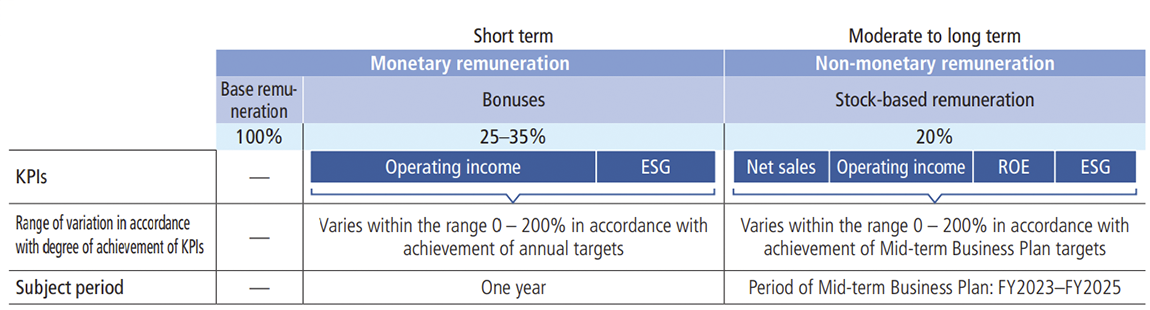
Remuneration for Directors other than Outside Directors consists of a fixed base remuneration corresponding to the Director’s position, as well as bonuses and stock-based compensation linked to business performance and ESG indicators. Since FY2025, we have revised the weighting of the performance-linked component of remuneration, to pay performancelinked remuneration of 45 – 55 units (25 – 35 units of bonuses and 20 units of performance-linked share-based remuneration) per 100 units of fixed remuneration when the business-performance standard is fully satisfied (100%). The percentage of performance-linked remuneration (bonuses) for the President and Managing Executive Officers was also raised, to provide greater incentives to those in higher positions.
Since Outside Directors are appointed to provide advice based on broad-ranging knowledge and experience, they are paid a fixed base remuneration reflecting their roles and responsibilities.
■Compensation structure
■Bonuses
In addition to the annual amount of consolidated operating income, we have adopted ESG indicators (CO2 emissions as the environmental indicator, number of on-the-job accidents as the social indicator, and evaluation of the efficacy of the Board of Directors as the governance indicator). Directors are paid bonuses at fixed times of the year. We chose as indicators the amount of consolidated operating income and these ESG indicators to increase motivation toward steady growth in annual earnings and achieving ESG targets, which is one of the basic policies of the Mid-term Business Plan. In FY2024, consolidated operating income was 6.6 billion yen, and each of the ESG indicators showed improvement.
■Performance-linked stock-based compensation
The Board Incentive Plan (BIP) Trust was adopted to incentivize improvements in business results and boost corporate value over the medium to long term. Believing that growth in business scale and improvements in profitability and capital efficiency contribute to boosting corporate value over the medium to long term, we use as indicators achievement of the Midterm Business Plan’s targets for consolidated net sales, consolidated operating income, ROE, and ESG indicators (CO2 emissions as the environmental indicator, engagement survey score as the social indicator, and evaluation of the efficacy of the Board of Directors as the governance indicator).
At the end of the period covered by the Mid-term Business Plan or upon the executive’s retirement, shares corresponding to 50% of the number of points calculated based on points allocated annually to each position multiplied by a performance-linked coefficient varying in the range 0 – 200% depending on the extent of achievement of the indicators are awarded. The remainder is paid in the amount equivalent to the conversion price of the shares. The Mid-term Business Plan targets for the final year of the plan, FY2025, are consolidated net sales of 185.0 billion yen, consolidated operating income of 11.0 billion yen, and ROE of 8%. Results in FY2024 were 159.6 billion yen, 6.6 billion yen, and 5.6%, respectively.Progress was made on each of the nonfinancial ESG indicators as well.
How compensation decisions are made
The Nomination and Compensation Committee, whose membership consists of a majority of Outside Directors and which is chaired by an Outside Director, is intended to improve the objectivity and transparency of matters such as Director compensation.
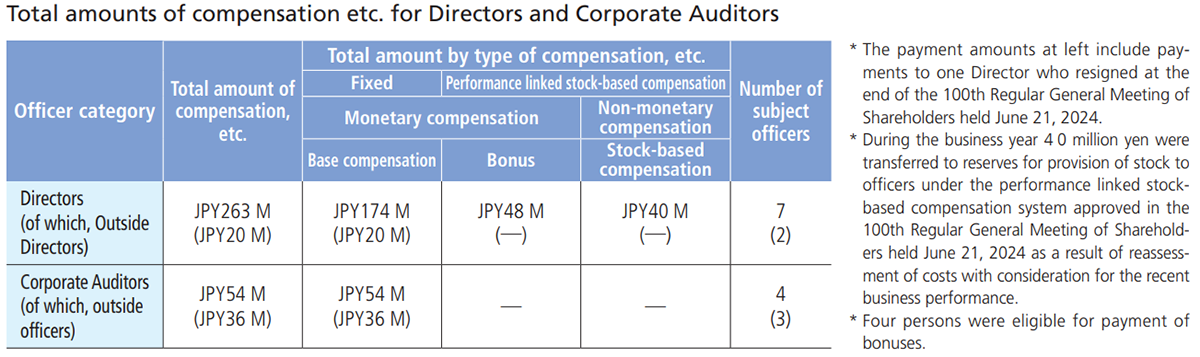
The Board of Directors decides on annual compensation within the extent determined through a resolution of the General Meeting of Shareholders. It also decides on the details of compensation for individual Directors in consultation with Nomination and Compensation Committee, whose membership consists of a majority of Outside Directors. Compensation and other matters for Corporate Auditors are decided in consultation with the Corporate Auditors, within the extent determined through a resolution of the General Meeting of Shareholders.
Compensation levels
Compensation levels of Directors and Corporate Auditors are determined each year with reference to levels at manufacturers similar to the Company in matters such as size, industry, and form of business from executive compensation data provided by an external organization, to verify the objectivity and validity of levels.
Analysis and evaluation of the efficacy of the Board of Directors
We carry out annual analysis and evaluation of whether the Board of Directors is performing its role effectively, based on evaluations by Directors and Corporate Auditors.
1.Process and methods for evaluating the efficacy of the Board of Directors
In FY2024, for the first time, we asked an independent agency to carry out objective verification of our annual evaluation of the efficacy of the Board of Directors. This agency conducted individual interviews based on the results of a survey of all Directors and all Corporate Auditors. The Board of Directors is discussing its efficacy based on the results of analyzing the report from the independent agency.
We also evaluated the efficacy of the Nomination and Compensation Committee and the Outside Officer Council Meeting.
Subject themes of survey questions * Graded on a 1-5 scale and free-form comments
- 1Board of Directors composition and management
- 2Management strategies and business strategies
- 3Business ethics and risk management
- 4Management team evaluation and compensation
- 5Dialogue with shareholders and others
- 6Nomination and Compensation Committee (responses gathered from Nomination and Compensation Committee members only)
- 7Outside Officer Council Meeting (responses gathered from Outside Officer Council Meeting members only)
2.Issues identified in evaluations of efficacy, and status of addressing them
Issues identified in the previous year’s (FY2023) evaluations of efficacy, and measures to address them
- 1Human resource strategy, human resource development
- Visualization (sharing) of the progress of improvement measures based on the engagement survey
- Drafting and implementing measures to ensure diversity of core human resources
- 2New businesses
- Further enhancement of discussions of strategic business with growth potential
Initiatives Addressing Issues
- 1We recognize progress on certain initiatives to promote improvements based on the engagement survey. Nonetheless, discussions of human resource strategy and human resource development as management strategies remain inadequate. The Board of Directors must continue to address these matters as priority management topics.
- 2While discussions of new products and the implementation of the new-business creation challenge program are positive developments, the Board of Directors must continue to address these as priority management topics.
3.Results of evaluations of efficacy in FY2024
No serious concerns were identified regarding the efficacy of the Board of Directors in FY2024. The function of the Board of Directors, its deliberations, its composition, and other matters are largely considered to be appropriate. We believe the efficacy of the Board of Directors as a whole is secured.
The following issues were identified in evaluations of efficacy in FY2024.
FY2024 issues
- 1Enhanced discussions of strategies and management issues from a medium- to long-term perspective (including human resource strategy, human resource development, and new businesses)
Response: Revising the Board of Directors regulations (revising standards for submittal and reporting) ➡ Revised
Response: Implementing offsite meetings ➡ Held between the President & CEO and Outside Directors since May 2025 and planned for periodic implementation in the future - 2Rectifying knowledge gaps between outside directors and internal Directors
Response: Establishing opportunities for dialogue on important management topics between Outside Directors and the executive side
In the future, we plan to make the Board of Directors more effective by implementing these responses as needed and assessing their results to enable further improvements. In addition, we will link such evaluations of efficacy of the Board of Directors to appointment and remuneration processes and governance functions, through means such as making revisions as needed in candidate selection and remuneration design.
These evaluations of efficacy newly recognized the Board of Directors’ strengths, as shown below.
Strengths of our Board of Directors
- 1Outside officers are able to offer constructive opinions freely.
➡ The chairman has established an atmosphere in which it is easy to speak and skillfully draws out the opinions of outside officers.
➡A virtuous cycle is in place in which the executive side takes diligent action on issues or assignments remaining after discussions, and this enables further discussion.
➡ Matters for review identified go beyond matters requiring decision and reporting. - 2The composition of membership is appropriate. Outside Directors draw on their knowledge, experience, and abilities to contribute.
➡ Independent Outside Directors use their individual backgrounds to advise the Board of Directors and contribute to the Outside Officer Council Meeting and the Nomination and Compensation Committee as well. - 3 Highly transparent, with heightened awareness of matters related to improvement
➡ Through an emphasis on presenting the bad news first, the Board of Directors shares information in the relatively early stages. - 4Meetings of the Nomination and Compensation Committee and Outside Officer Council Meetings play active roles.
➡ They function as effective opportunities for information-sharing and communication among outside officers while producing forceful counsel on the executive side.
➡ Active steps are taken in areas such as identification of human resource requirements and 360° evaluation.
Cross-shareholdings
Policy on cross-shareholdings
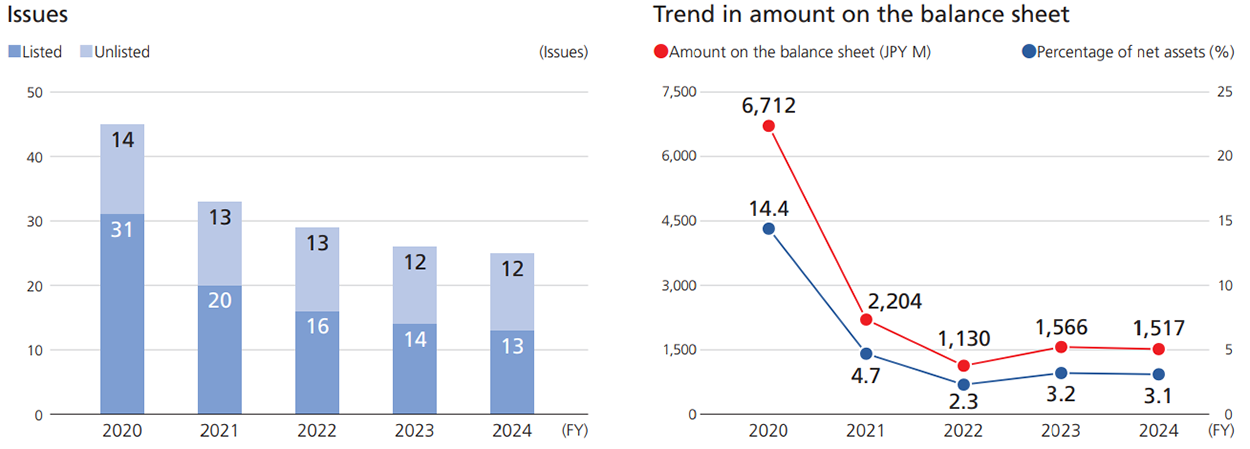
In principle, the Company does not hold cross-shareholdings of listed shares except when doing so is recognized to be meaningful and rational for purposes such as building favorable ties with trading partners, smooth and efficient business execution, and enhancement of future Company business development from the perspectives of the Group’s sustained growth and increased corporate value over the medium to long term. In addition, every year the Board of Directors verifies various specific matters, including whether the reasons for individual cross-shareholdings and the risks and benefits of holding these shares are sound in light of their capital costs. It then determines whether to reduce the holdings. Through this process, the Company may retain certain cross-shareholdings to enhance ties with the issuing firms. Our general policy, however, is to continue to sell issues for which the meaning and rationality of holding is judged to be insufficient.
The exercise of voting rights and the determination of whether to approve or reject resolutions are based on careful individual review of whether they would contribute to increasing the issuer’s corporate value and whether there is a risk of harming the Company’s corporate value.
Key items related to internal control
Enhancement of the functions of the Board of Directors and the Board of Auditors systems
The Board of Directors is a forum for directing the overall management strategy of the Group, and while ensuring swift decision-making, it formulates basic management policies, decides on matters stipulated by laws and regulations, the articles of incorporation, and other important matters related to management, and supervises the execution of duties by directors. In addition, outside directors and outside auditors attend the Board of Directors meetings, ensuring fairness and transparency in decision-making regarding business execution.
In addition, in order to pursue more effective corporate governance, we strengthen the supervisory function of the Board of Directors by exchanging information and sharing understanding among independent outside directors at the Outside Officers Liaison Council, which is a sub-organ of the Board of Directors.
Strengthening of compliance with laws and regulations and crisis management through deliberations on business execution at management meetings
We hold regular weekly management meetings composed of directors, auditors, and executive officers, where we deliberate and respond to important business execution, compliance with laws and regulations, and crisis management.
Internal control over financial reporting
The Internal Control Committee and the Board of Directors have evaluated that the internal controls related to financial reporting for fiscal 2022 are effective in accordance with generally accepted evaluation criteria. In addition, we have received an audit opinion from the audit corporation that this evaluation is appropriate.
Strengthening of the internal control system
We review the "Basic Policy on Internal Control" every year and make resolutions at the Board of Directors' meetings, and disclose the status of its operation in our business reports.